Rückblick auf das Enterprise 2.0 Forum in Köln

Ich bin zurück vom E2.0 Forum in Köln – und ich bringe ich eine Vielfalt von Eindrücken mit. Nachdem bereits im Workshop Herausforderungen bei der Einführung von Social Software im Unternehmen und bei der Abendveranstaltung intensiv diskutiert wurde, setzte sich dieser rege Austausch am Konferenztag noch einmal fort (in der Tat ist ein Hotel wie das Excelsior als Veranstaltungsort gut geeignet, es finden sich bspw. verschiedenste bequeme Rückzugsmöglichkeiten um ungestört weiterdiskutieren zu können und auch die Seminarräume haben Klasse, s.u. eine Aufnahme vom Workshop von Kai Nehm). :
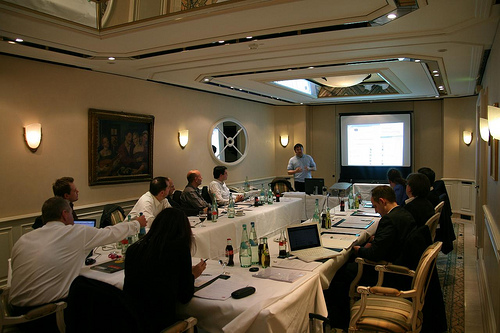
workshop_e20forum

Nicht nur im Workshop war es auffällig dass die Herausforderungen und Fragen der Teilnehmer sich oft ähneln, auch wenn die Firmen aus unterschiedlichen Branchen stammen, unterschiedliche Größen aufweisen und (in der Vergangenheit) unterschiedliche IT-Strategien verfolgten. Andererseits zeigten die vorgestellten Fallbeispiele (ABB, Bayer, Lufthansa, Vodafone, Fraunhofer Gesellschaft) recht unterschiedliche Vorgehensweisen. Nun ja, es ist nur natürlich dass es für ein komplexes Thema wie die Einführung von Enterprise 2.0-Elementen in Unternehmen weder Königswege, noch triviale Algorithmen und simple Vorgehensmodelle geben kann.
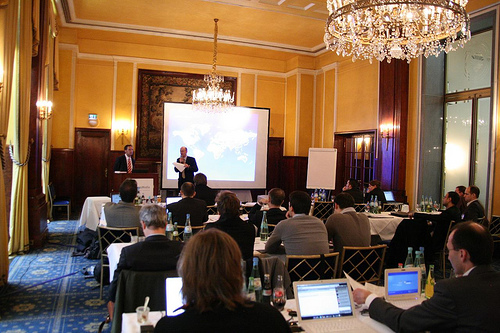
conference_e20forum

Aus meiner Sicht ist das nicht beunruhigend, sondern vielmehr ein positives Zeichen: Wenn unterschiedliche Problemlösungen zum Erfolg führen stimmt die grundsätzliche Richtung von Enterprise 2.0. Zusätzlich ergeben sich daraus auch Hinweise auf sinnvolle Kombinationen aus Methoden, Werkzeugen und Prinzipien der Implementierung. Sicher, die vorgestellten Projekte sind unternehmens- und kontextspezifisch, dennoch können einige allgemeine Daumenregeln abgeleitet werden. Neben klassischen Merksätzen des organisatorischen Change Managements wie bspw. “fordern und fördern (der Nutzer)”, “Betroffene zu Beteiligten machen” oder “kennen, können, wollen und sollen” ergeben sich eine Reihe von Aufgaben und zu überprüfenden Ideen und “Checkpoints”. Im Open Space Workshop zur Strategiefindung wurde u.a. die Bedeutung der Sprache für eine erfolgreiche Argumentation hervorgehoben. Diese richtet sich natürlich an verschiedene Stakeholder – vom konkreten Betroffenen, der in erster Linie Interesse am persönlichen Nutzen hat, der sich durch die Veränderungen für ihn ergeben kann, bis hin zu Entscheidern, die grundsätzlichere Fragestellungen (ja, auch die Frage nach dem RoI zähle ich dazu) haben. Einige Anknüpfungspunkte lieferte hier Dr. Frank Schoenefeld von der T-Systems MMS, der in seiner Keynote das Wertversprechen von Enterprise 2.0 konkretisierte, seine Folien verlinke ich hier sobald verfügbar (das Pre-Conference-Interview findet sich auf Englisch auch im enterprise2open-Blog, dort werde ich auch meine Eindrücke von der Keynote von David Terrar bloggen).

Insgesamt eine sehr gelungene Veranstaltung, die im Oktober im E20SUMMIT sicherlich eine Fortsetzung finden wird. Mehr Eindrücke finden sich u.a. im Kom-blog, bei Kai Nehm (der u.a. einen meiner Tweets als Screenshot zitiert), die Liste wird erweitert …

Building Web 2.0 Enterprise: McKinsey Global Survey Results

This wednesday I got interviewed by a master student who’s writing a thesis on the cultural implications of Enterprise 2.0 (he promised to share his findings with me, so stay tuned …). Whatever, during our talk I argued with this late McKinsey survey (“Building the Web 2.0 Enterprise“) about reasons and traits that make Enterprise 2.0 projects and corporate implementations successful. Reason enough to examine it again, even when the survey doesn’t tell us much about methodology, nor about who got selected into the round of participants. But hey, actual numbers are always interesting, and the underlying models and assumptions are even more so. And as McKinsey is known for being heard in corporate boardrooms, it’s relevant (and you notice the pattern …)

One interesting point is the prevalence of knowledge management as area for enterprise 2.0 usage. I said this before, Enterprise 2.0 can breathe new life into a field that once seemed so out of date.

Another thing that I noticed is that organizations that are satisfied with their Enterprise 2.0 efforts are overall effecting more changes to organizational structures and processes than those that aren’t satisfied. This is something that Bertrand Duperrin notes too:

This is what to conclude from this McKinsey Survey (by the way, it confirms what I’ve been thinking for years) that tries to bring us a view of the state of the art in enterprise 2.0 adoption. At first sight I really didn’t like the title “building the web 2.0″ enterprise because it would suggest tools are central in organization. Fortunately, their survey shows it’s really the opposite.

First conclusion : bringing web 2.0 within the enteprise is not a fad but a heavy wide-range trend : internal, external, various tools, wide perimeters of experiment. Second conclusion : promises are not as easy to be delivered than many thought.

It’s not a suprise for me and it matches what I observed. Two kind of companies are emerging : those who had a tool-centric view and thought the rest will follow, and those who used tools as pieces of an organization change process.

[…]

Well, you need to change, and please don’t just see it as an add-on. The willingness to change the organisation, mind-set, processes and culture is the key factor. Scary, soft, social stuff that needs to be understood when trying to improve collaboration. And companies should learn a lot from their own “Intranet 1.0″ (and knowledge management) failures (and successes) before setting out for an Enterprise 2.0 journey …

The digital company – freedom to collaborate

I am closing down some of the open tabs, cleaning up draft versions and stuff I always wanted to blog about. Not all drafts stand the test of time, but some do. On the topic of good organization the report Digital company 2013: Freedom to collaborate written by Kim Thomas for the Economist Intelligence Unit stays interesting. Some of the key themes explored by the report are

  • Technology knowledge will permeate the enterprise.
  • Social networks will be common in the workplace, like it or not.
  • Beware information paralysis.
  • Digital tools will democratise access to information.
  • Digital tools provide employees with greater control over the information they can access.
  • IT will also need to loosen the reins.
  • Ceding technology control will be good medicine.

And they note that in order to realise the benefits of improved collaboration business leaders must come to terms with autonomy: “for employees, in how they access information and spend their work time; and for business units, in what technologies they purchase and how they use them. Above all, it will require from executives a great deal of courage—to allow technology to bring customers and other third parties into the company’s operations—and trust in their employees to access and use information freely.”

In Auto industry and Enterprise 2.0 Andrew McAfee speculated what he would do if appointed “Detroit CIO”. While the set of 10 principles he’s applying is good, I am not too convinced that technology, i.e. rolling out emergent social software platforms (ESSPs) to all employees of the company, starting internal CXO blogs etc. would do the trick. The car industry is a heavy user of IT already, adding to the pile of tools won’t help in overcoming resistance. And that’s where the rub is: implementing Enterprise 2.0 concepts must cope with the people, processes and the tools they employ in these processes (I specifically doubt that Six Sigma or Lean Production processes can benefit much from Enterprise 2.0 concepts, these are repeatbale and highly automated processes, i.e. they don’t need no flexibility, adaptivity or emergence). But some other advanced (knowledge work) processes might benefit a lot – hey, collaboration and social software might even help in turning around a basically flawed business model, so Andrew’s thought experiment is very welcome.

Then, IBM Research is looking at adoption, usage patterns, motivations, and overall impact of Social Software in the Workplace (pdf). The paper focuses on the internal usage of social networking (Beehive) and examines the individual goals people have when utilizing these platforms (like interacting with colleagues, career advancement, convincing and informing others about ideas and projects).

Via Stewart I found Gerard Tellis & Ashish Sood‘s article “How to Back the Right Technology” in the Wall Street Journals and MIT Sloan’s Business Insight – dealing with mistakes organizations often make when choosing which technologies to adopt:

  • They fail to distinguish among different levels of technology, with the result that they focus too much on one level and get tripped up by changes in another level.
  • They assume technological performance follows a standard path — from innovation to obsolescence. It often doesn’t.
  • They fail to recognize that technological innovations shape consumers’ tastes, not mere whims.

Good advice included, like e.g. try multiple things at once and don’t bet too heavily on one choice, on picking a winner:

  • […] Technologies, and the competition among them, evolve in more-complex ways than conventional wisdom suggests. To make the right choices, managers need to understand these patterns of evolution.
  • [so that] executives can avoid some common mistakes: missing a market-changing technological breakthrough, embracing a hot technology too eagerly or abandoning another one too quickly, and underestimating the effect of new technologies on consumers’ tastes.

And if you’re in doubt what technologies to evaluate for 2009 EDS’ Charlie Bess gives you something to think about, see his predictions for 2009 (granted, a mixed bag of IT technologies and/or approaches). To me, most important and most interesting is his starting point:

In this [financial et al. crisis] situation, the investments in technology can actually have more impact than at any other time, since your competitors may be in a purely cost cutting mode. In 2009 organizations must maintain a balance between the new/strategic and the immediate return, between operational cost-cutting and operational excellence. Anytime there is this level of conflict, the situation is ripe for innovation

Well, basically looks like a good situation for social software in the enterprise aka Enterprise 2.0 …

Rückblick auf den ECM-Summit – Pre-Conference Workshop

Blogs – die Wochenendmagazine des Web? Nun ja, die zeitnahe Begleitung und Dokumentation von Konferenzen findet zunehmend in direkteren Kommunikationskanälen wie Twitter statt. So habe ich für den ECM Summit erstmalig – ergänzend zu meinem Standard-Account einen Konferenz-Account eingerichtet.

Beim ECM-Summit waren Björn (u.a. hier) und ich die einzigen Live-Tweeter, andererseits haben einige Teilnehmer die Einträge interessiert verfolgt und sich direkt gemeldet (immer nett wenn man es auf diesem Weg schafft sich auch persönlich kennenzulernen – hat mich gefreut). Oft sind es ja die Gespräche in den (Kaffee-)pausen die auch nachhaltigen Eindruck hinterlassen. Wenn dann noch ein “Socializing”-Programm dazu kommt sind interessante Gespräche garantiert. So habe ich mich am Montag abend ausgiebig mit Lee Bryant von Headshift unterhalten – zum ersten mal richtig ausführlich nachdem wir uns wiederholt bei Konferenzen wie der Web 2.0 Expo, reboot u.a. getroffen haben. Das Chicken Tandoori hat uns beiden ausreichend Gelegenheit zu längerem Austausch gegeben – und dies beileibe nicht nur zu Social Software Themen (Danke Lee, ich überdenke die Urlaubspläne für 2009 …). Übrigens, Björn hat im Vorfeld des ECM-SUMMIT ein Video-Interview mit Lee Bryant geführt.

Blogs haben ihre Stärken in der Reflektion und der vertieften Betrachtung – allerdings ist das für eine Veranstaltung wie den ECM-Summit anspruchsvoll: fast durchgehend wurden mehrere Tracks angeboten, eingerahmt von intensiven Keynotes. Meine Interessen spiegeln sich so in der Auswahl der besuchten Tracks – speziell am ersten Tag, d.h. im Pre-Conference Workshop. Neben Workshops zu Intranet-Usability (mit Florian Bailey) und Intranet-Governance (auch spannend) wurde ein Wiki-Workshop mit meinem Beraterkollegen Markus Glaser von Hallo Welt! angeboten. Anders als in Köln war es dieses Mal ein ganztägiger Workshop in kleiner Runde, wodurch sich Raum für intensive Diskussionen und Fragen, auch zwischen den Teilnehmern, ergab. Meine grundsätzliche und nicht zum ersten mal getroffene Beobachtung ist es, dass an Unternehmenswikis Interessierte oft ähnlichen Fragestellungen gegenüberstehen. Natürlich bestehen unterschiedliche Vorstellungen und Ziele, und es macht einen Unterschied ob bspw. evaluiert werden soll ob Wikis eine Alternative und/oder Ergänzung zu bestehenden Intranets sein können oder ob Optimierungs- und Skalierungsmöglichkeiten für bestehende Wikis gesucht werden. Aber die spannenden Fragen sind meistens generisch – entsprechend dem Aphorismus dass es zu 90% um weiche Faktoren, Unternehmenskultur etc. geht und nur zu 10% um Hard Facts wie bspw. “Welche Wiki-Engine soll verwendet werden?”

Gemeinsam sind u.a. Fragen der Akzeptanz, also bspw. wie Mitarbeiter zur Mitarbeit und Partizipation animiert und motiviert werden können aber auch die Suche nach Erfahrungen und Ideen für die Implementierung (bspw. die Frage nach geeigneten Use Cases und Nutzenszenarien – idealerweise mit nachvollziehbaren RoI-Kalkulationen). Damit zusammenhängend ist auch die Frage wieviel Struktur in Unternehmenswikis notwendig ist (und wie sie entstehen kann, ob und wieviel vorgegeben werden muss etc. – grundsätzliche Fragen der Informationsarchitektur inbegriffen). Offene und veränderliche Ordnungsstrukturen, die flexibel an Anforderungen und Gegebenheiten angepasst werden können, sind anspruchsvoll. Sie stehen aber nicht im Widerspruch zum klar definierten Zielen und Einsatzarenen.

Web 2.0 Expo Europe: Improving Your Site’s Usability – What Users Really Want

These are my notes from the second Expo workshop with Leisa Reichelt, on Improving Your Site’s Usability – What Users Really Want. Here’s the post covering the morning workshop: Collaboration Techniques that really work.

Now let’s see:

  • It ain’t really funny, but yes, in usability no two experts have got the same understanding. Usability is a field full of theories, many good books out there, and some good blogs too I guess.
  • To achieve something that works for the user (hey, this is important for behind the firewall Enterprise 2.0 stuff too) we need both rules and testing, i.e. design guidelines and rules, common conventions and all are not enough to ensure success. Some rules have lost their relevance by now (e.g. three clicks to rule it all …)
  • In the field of usability we’re dealing with human brains – these are good at a lot of things, but can be fooled easily (they have finite storage capacity, like when short term memory struggles to store more than about nine things, trying to deal with this e.g. by chunking up things together only works a bit. When attention is a limited commodity we tend to do one decision at a time and stick to habits and learned procedures (yes, these are useful at times, as they require no attention). Our long term memory stores only what we can’t easily deduce (via mental shortcuts and “lifehacks”).
  • What else? Interruptions burden our short term memory, switching between tasks takes effort, in modern life unexpected things happen all the time (can you spell Twitter?) making it hard to form habits, yet computers and software expects us to remember how to do things. Here, Leisa talked about the Principle of Commensurate Effort, i.e. people will spend a considerable amount of effort on things that is in proportion to the value they perceive (reminds me both of Bruno Figueiredo’s talk and the notion of “early adopters will use anything” and the Twitter failwhale). Well, yes, even when people are putting up with it, it’s no excuse for bad usability design – and there are good reasons to this too (adoption rests on the motivation of your early adopters, treat them well).
  • Leisa talked about Alan Cooper and “polite computing” (14 Principles of Polite Apps, pdf), i.e. software that is interested in me, perceptive, forthcoming, self-confident and responsive. Great rules and lifehacks: make the easy easy, and the difficult possible (yes, wikis make that sound natural), make it quick to scan & digest, avoid clutter and text-only (well, tagclouds are a different beast in my book), users read when needed and avoid it when not needed …
  • More user adoption lifehacks: speak the right language (avoid marketese, legalese, technese), lay information scents, i.e. use keywords to guide people in the right direction, people will sniff it out, much like the way they will when you try to foul them (yes, well put, seeing these effects e.g. in wiki portal site usage, when people are avoiding the nicely done navigation and go directly into search mode, and when they rely on the breadcrumb navigation).
  • Leverage seducible moments (Jared Spool, see e.g. The Search for Seducible Moments). i.e. “there are specific moments where designers are most likely to influence a shopper to investigate a promotion or special offer. Most of the time, these moments come after the shopper has satisfied their original mission on the site. If we identify the key seducible moment for a specific offer, we can often see over 10 times as many requests”. I wonder how this can be used for intranet application design, got some ideas but need to rework them …
  • Support users in a rush, as the paradox of the active user is dreadful (I haste to get rapid results, ergo I make mistakes, making me slower, …), give feedback (“you’re doing great!”). Hmmm, sites should give lots, probably that’s behind one of the great things about wikis – they provide instant gratification.
  • don’t under-estimate “tunnel vision“, people are able to ignore a lot, i.e. banner blindness, don’t underestimate the task focus of users – they ignore most stuff. Yes, you need to know what they want to do and get them there, and you need to have an experience strategy.
  • User Centered Design as such is interested in both strategic and tactical elements. Whereas Steve Krug’s “Don’t make me think” is on a strategic level, Luke Wroblewski’s  “Web Form Design” is on a tactical level.
  • Why do UCD (in Enterprise 2.0)? Four key benefits are increased revenue, reduced project risk, reduced customer support costs and more customer retention (yikes, yes, internal users of our systems are customers too ;). All too often project teams don’t understand genuine user requirements (easy, users don’t understand their own requirements themselves at times) – at the same time making late changes is slow and expensive.
  • Some ideas: Don Norman and The Design of Everyday Things (“we tend to project our own rationalisations and beliefs onto the actions and beliefs of others”), Jakob Nielsen “to design an easy-to-use interface, pay attention to what users do, not what they say“, user research helps you uncover, understand and design for REAL user requirements.

Now, check out the slides:

Rückblick auf meine Sessions – Tag 1 des BarCampBerlin3

BarCamp Berlin 3

Ein paar Notizen zum ersten Tag beim BarCamp Berlin 3 – insbesondere zu den von mir besuchten Sessions, die Folien und Notizen zu meiner Session “Unternehmenskultur und Enterprise 2.0” folgen.

  • E-Learning 2.0 (scooyoo.de o.ä.)
  • Wissensmanagement 2.0

Die Session zu E-Learning 2.0 hat mich nicht begeistert, zum einen war das mehr eine Firmenpräsentation, zum anderen war das nicht so innovativ. Im Grunde nicht mehr als die “Internetifizierung” von klassischen Edutainment-Angeboten für Schüler – halt eine Internetplattform. Es waren keine Social-Learning Elemente erkennbar, abgesehen von Dingen, die ich eher kritisch sehe. Was bringt es einem Schüler wenn er sieht dass er auf Platz 267 von 500 Schülern ist (Rating? …) – ebenso fand ich es fragwürdig dass das Feedback im Lernprozess eher trivial war. Auch das Fragendesign (bspw. Lückentexte in die die passenden Worte “hineingezogen” werden müssen) war nicht überzeugend. Ob das der aktuelle Stand des pädagogischen Herangehens für Mittelstufenschüler ist?

Zweite Session zu Wissensmanagement 2.0, mit Stefan Ehrlich von T-Systems MMS, diese hatte mehr einen einführendenCharakter, bzw. war ein Erfahrungsbericht aus dem Einsatz bei der MMS. Einige Notizen:

– alt: Wissensmanagement 1.0 – Informationsverwaltung und -verteilung. Ja, ” “Wissensmanagement” ist zwischenzeitlich aus der Mode gekommen, mit Enterprise Social Software wird das “wiederbelebt”
– einige Ausführungen zu den Erfahrungen der MMS mit dem Teamweb (u.a. wurde auch kurz das Strategie-Wiki angesprochen, das übrigens auch in diesem Interview mit Peter Klingenburg Thema war), zuerst aber zum Hintergrund der Firma. Mit drei Worten: Profit Center Organisation. D.h. auch verteilte Kompetenzen in den einzelnen Centern, mit der Folge dass die Zusammenarbeit in diesen großen Einheiten nicht einfach ist, auch weil verschiedene Sprachen und Terminologien in den verschiedenen Centern bestehen. Gleichzeitig gibt es viele Gemeinsamkeiten, bspw. Projektmanagement als grundlegende Methode.

Die Frage war nun wie die Kommunikation zwischen diesen Einheiten gefördert werden lann (ich würde ergänzen, dass es mehr noch darum geht die Kollaboration zu fördern). Die bis dato verwendete Lösung war es Competence Centers für die bereichsübergreifende Abstimmung zu installieren, diese fokussierten sich vor allem auf diese überall benötigten “Gleich-Kompetenzen”. Allerdings passierte in den ergänzten Competence Centern nicht viel, die Aktivitäten waren überschaubar – nach wie vor waren die Profit-Center der Schwerpunkt des Business (selbstverständlich, ja).

Was also tun? Coaching, Leadership und “Anreizsysteme” (ja, kritisch), Veränderung der Motivationsstrukturen und der Unternehmenskultur, … mehr dazu später im Post zu meiner Session (“Unternehmenskultur und Enterprise 2.0”).

Was wurde bei der MMS gemacht? Relativ ungezwungene Einführung eines Confluence-Wikis als “Experiment” und die Beobachtung was sich an emergenter Nutzung ergab, d.h. was wurde mit dem Werkzeug wirklich gemacht? Eine Beobachtung war es, dass sich auf der Wiki-Plattform die Profit-Center Struktur nicht widerspiegelt – es bilden sich vielmehr thematisch bezogene Communities heraus. Allerdings war bei der MMS die Nutzung der Plattform nicht natürlich, auch hier bestehen nach wie vor Bedenken und Ängste, bspw. vor kritischem Feedback. So nutzen manche das Wiki nur für Basisaufgaben wie bspw. die Vor- und Nachbereitung von Meetings, nun ja das ist meiner Meinung nach nicht notwendigerweise schlecht, die Hauptsache ist es ja dass es überhaupt genutzt wird.

Eine der Erwartungen war es Expertise bzw. Mitarbeiter mit Expertise durch das Wiki leicht auffindbar zu machen – in der Folge wird das Teamweb im wesentlichen auch dafür genutzt. Das zugrundeliegende Paradigma ist mithin: es geht weniger um “Codified Knowledge”, als um das Finden von MA die Probleme lösen können. Klar, personenfokussiertes Wissensmanagement ist prinzipiell ein guter Ansatz – hat aber natürlich auch Nachteile u.a. ist das noch keine Lösung für den Wissenstransfer (und auch keine Lösung wenn die Kompetenzträger das Unternehmen verlassen würden). Kodifiziertes Wissen ist zudem auch nicht einfach, u.a. weil Wissen stark vom Kontext abhängt – in der Folge kann es schlecht zwischen heterogenen Kontexten transportiert werden.

Die MMS plant nun mehr Unterstützung und Verständnis beim Management zu schaffen (die Vorteile zeigen, um Budget und Support etc. zu bekommen), sowie die Einführung eines Employee Social Networks im Unternehmen. Ich denke das macht Sinn, gerade um die “Knowledge Hubs” im Unternehmen zu identifizieren, und diese als Ausgangspunkte für Knowledge Cluster gewinnen. Eine Möglichkeit ist es, dass sich die Kompetenz- und Wissensträger quasi “selbstselektieren” können, und letztlich vorrangig flexible Plattformen bereitzustellen, die die Ausformung der Wissensnetze unterstützt aber nicht vorgibt. Ein Problem ist ja, dass gerade die Mitarbeiter mit den spannendsten Kompetenzen oft am wenigsten Zeit haben, bzw. unwillig sind ihr Wissen zu teilen. Positiv formuliert – oft haben genau diese Leute keine Zeit ihr Wissen zu teilen, sie “fahren besser” wenn sie weniger sichtbar sind, da dann mehr Zeit für die persönlich als spannender empfundenen Sachen bleibt. Dahinter steht die Aufgabe wie man diese Aufgabe der Wissensverteilung zu einer spannenden Aufgabe machen kann bzw. wie man diese Experten (nachhaltig) motivieren kann.

Es geht um die persönliche “job satisfaction” dieser Leute – klar, manche machen das sehr gerne, sind quasi natürliche Evangelisten. Andere wollen mehr Experte bleiben und nicht so viel kommunizieren (und das ist meiner Meinung nach ein weiterer “Leverage Point” – um die Expertise zu skalieren können Knowledge Blogs ein gutes Instrument sein).

WikiFest – Practice what you preach

Stewart shares another two of the WikiFest presentations, one by Martin Seibert (confessing Wiki-Bully, he is), the other one by Camille Goksever of Chevron. While the latter one is hurt by the missing audio track (though I like the pictures and the conveyed ideas) Martin Seibert’s presentation is much more of a learning experience:

Granted, the wiki reports meme is stemming from a TWiki focus, but the second main idea of having showcases for your clients is resonating with me. I am doing something similar when I give prospective and actual clients access to a secured project wiki of mine. Thus they can try and learn while doing project coordination with me. Reduces the amount of email within the project team and supports effective work practices, while building deeper understanding of the issues at hand (adoption, motivation, need for coaching and “help”, …)